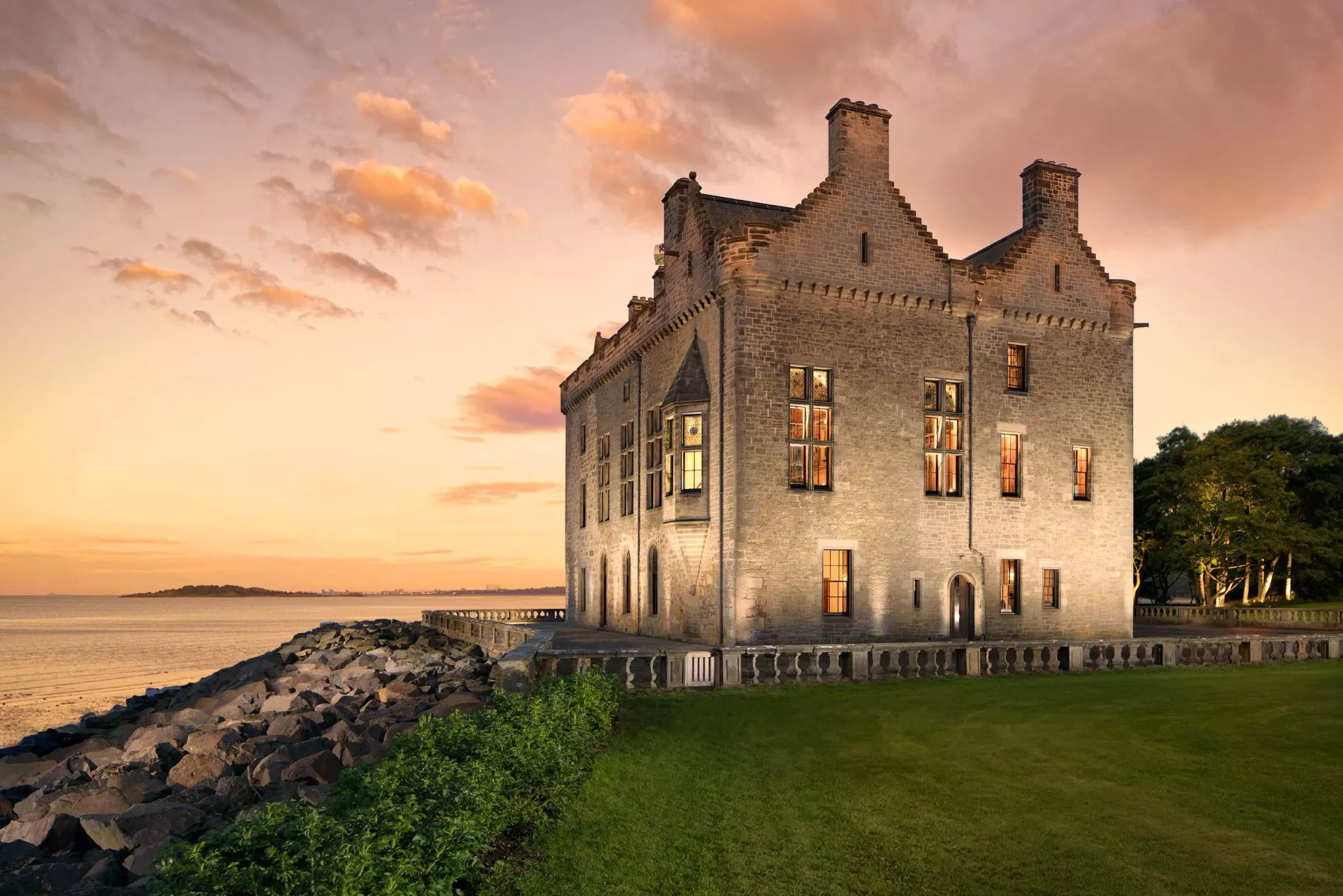
Barnbougle Castle has a colourful history. It was originally built in the tumultuous 13th century to protect a noble Norman family from its enemies. At the height of the British Empire, it was rebuilt by a Scottish statesman and became a retreat for quiet study and contemplation.
At the brink of land and sea
The castle is the formidable gateway to Dalmeny Estate from the Firth of Forth and the world beyond. Standing proudly on the shores of the firth, Barnbougle poses an immutable sanctum in defiance of tide and weather in perpetual flux.
From snug within the castle’s reassuring stone walls, painterly views over the water mesmerise and calm.
All in the name
Theories abound as to the meaning of “Barnbougle”. It is probably not a Gaelic word, but instead taken from the Welsh-related language of the local Celts.
“Bryn bugail” would mean “shepherd’s hill”. The hill behind the castle, now called “Thieves’ Brae”, would be an excellent lookout over the rich pastures along the shore.
The first owners
The builders and first owners of Barnbougle were the de Moubray family. They had come over from Calvados in Normandy with William the Conqueror in the 11th Century.
During a violent and chaotic time, the Moubrays were skilled survivors. Moubray was holding Stirling Castle for King Edward II during the latter’s defeat by Robert the Bruce at the Battle of Bannockburn. The next day, Moubrary wisely switched sides!
Roger de Moubray died in battle. His faithful hound, remaining at home at Barnbougle, howled uncontrollably.
The Primrose Family
The Primrose family, now Earls of Rosebery, bought the estate in 1662 and have been here ever since.
At this point, the charismatic figure of Archibald Primrose, 5th Earl of Rosebery, entered the history of Barnbougle Castle. The castle’s second life began.
Scholarly, charming, and gifted, but always with a hint of melancholy, the fifth Earl was brought up in the expectation that he would do great things.
He claimed when young to have three ambitions: to win the Derby, marry an heiress, and become Prime Minister. He achieved all three.
In the 1880’s, the 5th Earl turned his attention to Barnbougle Castle and commissioned a design to fit his new life. As a scholar’s retreat, it has six libraries and only one bed. As a statesman’s study, it has comfortable, welcoming rooms for meetings and conversations. From the balcony in the banqueting hall, he could practice his speeches.
90 years later
The spirit of the 5th Earl is deeply ingrained in the fabric of Barnbougle Castle. So much so that after his death in 1929, the building and its furnishings were kept almost entirely as they had been in his lifetime.
Today, although the castle’s facilities have been brought up to date, it maintains its original character. It gives the warm feeling that the man who built it for his own use and pleasure has only just stepped out.
The castle has reawakened for a new era as a luxury events venue.